On the Palm Beach coast, the epoxy is rarely the thing that fails. The slab underneath it is. A floor that bubbles and lifts in a Jupiter or Wellington garage was almost always coated before anyone measured what the concrete was doing from below — and on a barrier-island county sitting this close to the Atlantic, skipping that measurement is how a high-end floor turns into a redo.
Few places in Florida set a higher bar for finish quality than Palm Beach County. Buyers from the oceanfront estates of Palm Beach island and Manalapan to the show garages of Wellington's equestrian community expect a floor that looks flawless and stays that way. That expectation is exactly why moisture failure stings so much here: a homeowner pays for a premium metallic or flake system in the dry winter season, then watches it haze, blister, and peel once the summer rains arrive. The instinct is to fault the resin or the crew. The real cause was set in motion before the bucket was ever opened, by water the eye cannot see rising through the concrete. This guide lays out why the Palm Beach coast is one of the unforgiving places to coat a slab, the standardized tests that flag the danger early, and the questions that separate an installer who understands South Florida concrete from one who is about to cost you twice.
What Actually Peels a Palm Beach Floor
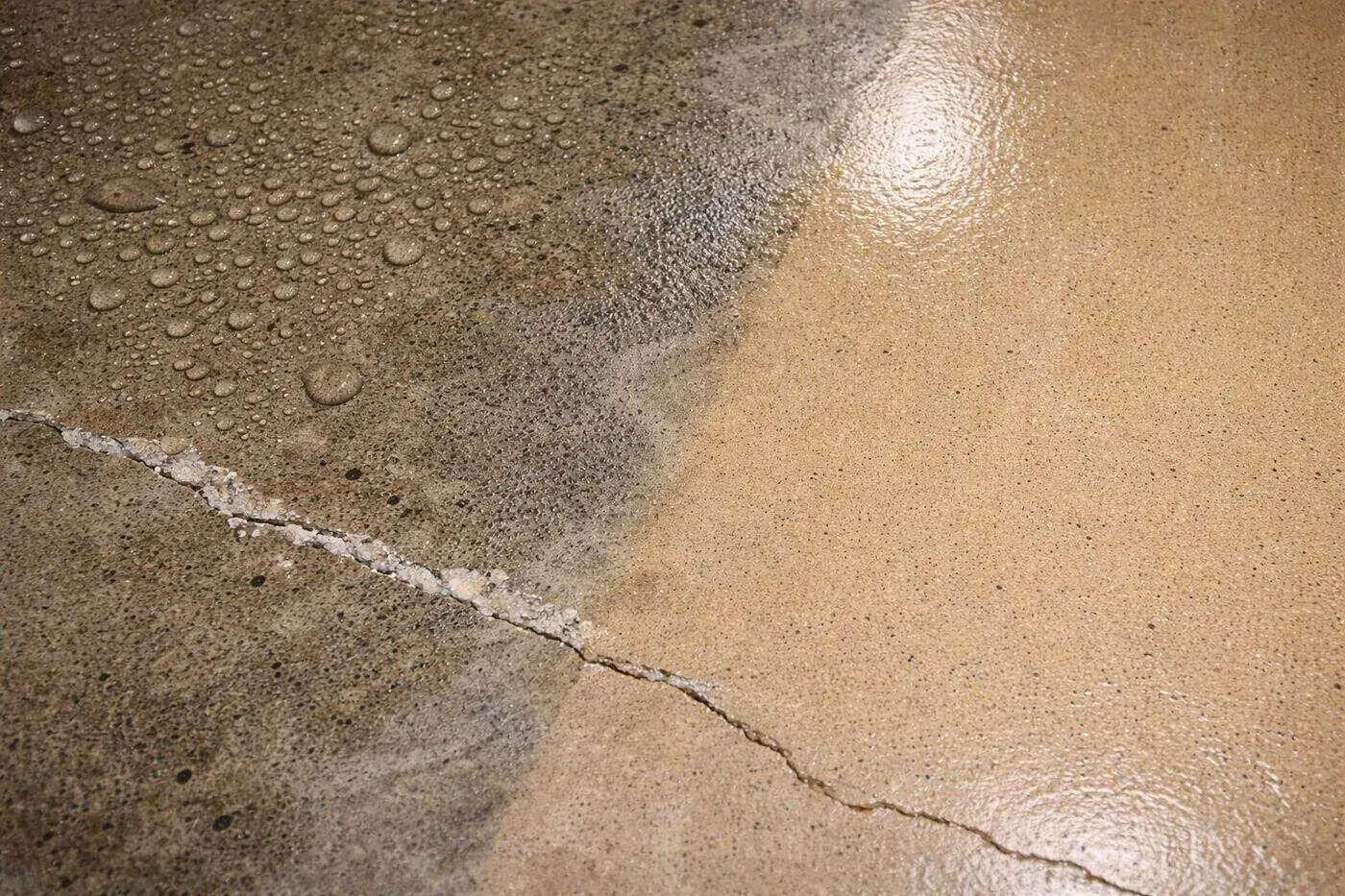
Start with the physics, because they make sense of the wreckage. Cured epoxy is one unbroken, glass-hard sheet locked into the open texture at the top of the concrete. The lock survives only as long as the slab beneath stays dry and steady — during the cure and for every year after. Set that against the Palm Beach reality and the failure writes itself: groundwater in the limestone evaporates, threads its way up through the slab, and bears against the underside of the film with a quiet, unending push. A wet season or two of that and the coating quits its grip — cloudy halos first, then raised blisters, then full sheets curling off at the joints like sun-baked wallpaper.
Moisture vapor transmission is the industry's name for it, and it tops the list of reasons a young floor dies. Be clear about what it is not. Not a bad pour of resin. Not a careless roller pass. Not a product you can warranty-return. It is a slab that went under coating before anyone proved it was fit to be coated. The good news — and the entire point of this guide — is that the pressure can be read in advance. Measure the slab and you can build a system that shrugs off a Palm Beach summer. Skip the reading and you are wagering your floor on luck.
Why the Palm Beach Coast Fights You Harder
The culprit is geology, plain and simple. The county sits on porous, water-holding limestone, and most of where people actually live is a low, flat coastal apron only a few feet over the tideline. Picture it on a map: out east, the Atlantic barrier islands — Palm Beach, Singer Island, Jupiter Island — ringed by water; then the waterfront blocks of West Palm Beach, Lake Worth Beach, and Delray Beach hugging the Intracoastal and the Lake Worth Lagoon; and inland, Wellington, Royal Palm Beach, and Loxahatchee running up to the edge of the Everglades. Under almost all of it, the water table hovers right beneath the foundation, pumping vapor into the slab every hour of every day.
Proximity to water turns the dial up further. A house on the Intracoastal, on a finger canal, or a short walk from the surf sits on about the wettest ground the county has, and the briny ocean air keeps ambient humidity pinned high, so the concrete almost never catches a dry spell to release what it is holding. Construction habits make it worse still: a great many South Florida slabs were poured directly on grade over a flimsy or aging vapor barrier, and on older homes that barrier may be long gone. Plenty of moisture shoving upward, next to nothing checking it — that is the standard Palm Beach hand, and it is why mitigation shows up as a normal line item here instead of the oddity it would be inland.
And none of this is a scare tactic dreamed up to sell an add-on. Put a calibrated meter on a Palm Beach coastal slab that looks and feels bone dry, and the number routinely lands well past the line where a coating can safely hold — high enough, often, that the concrete must be opened up and sealed with a vapor-barrier primer before any finish is trusted to last. What your eyes report and what the instrument reports are two different floors.
The 75% Line a Coastal Slab Fights to Cross
Here is the number that governs everything. Concrete holds moisture you cannot see or feel, and the figure that matters is its internal relative humidity — the reading taken deep in the slab, not the dryness of the top surface. Manufacturers want that internal figure under about 75 percent before a coating goes on; once a slab sits above it, the math on a lasting bond starts working against you, and on the Palm Beach coast crossing back under that line is the exception, not the rule.
The local climate stacks the deck against it. Outdoor air here runs near three-quarters saturated all year, annual rainfall clears 60 inches, and the daily thunderstorms of the June-to-October wet season keep the water table brimming and slabs feeding moisture upward. A second hazard rides along with the first: lay resin down on a muggy day and it can flash with amine blush, a hazy, greasy bloom that means the coating cured poorly and will not grip the way it should. Most Palm Beach summer afternoons carry that risk — and on the high-gloss metallic and quartz finishes buyers here favor, blush announces itself the instant overhead light rakes across the floor.
So the competent local installer treats the weather report as a starting point, not a verdict. The slab gets metered, the surface gets inspected, and the pour gets timed to conditions the concrete can actually take. Coat a slab still reading north of 75 percent and you have not finished a floor — you have set an appointment for it to fail.
Worried About Moisture in Your Slab?
We test before we quote. Get a straight answer about your concrete and a system built to hold in South Florida.
The Moisture Tests That Catch the Problem
You do not have to take anyone's word for the slab's condition, because the trade settled the question with standardized tests decades ago. Each one puts a real number on how much moisture the concrete is moving, and a serious Palm Beach installer runs at least one before pricing your job. Here are the three to recognize — and note that the ASTM evaluation, billed at $200 to $400 by many shops, comes free as part of your quote with us.
Relative Humidity Probe Test (ASTM F2170)
This is the one to trust above the rest. Sealed probes are set into small holes bored a measured depth into the slab, then left to read the humidity in the heart of the concrete rather than at the skin. Since that interior moisture is precisely what drives a coating off the floor, ASTM F2170 is the figure manufacturers tie their warranties to. Under roughly 75 percent and you are clear to coat; above it and the slab needs mitigation first — a result that, on Palm Beach's waterlogged coastal ground, turns up far more often than not.
Calcium Chloride Test (ASTM F1869)
The older quantitative method, this one weighs how much moisture the slab gives off at the surface over a fixed period, reported in pounds per 1,000 square feet per 24 hours. Three pounds is the usual ceiling for coatings; go beyond it and the vapor pressure is high enough that delamination becomes a real threat and a barrier is required. Still a legitimate check, but the RH probe has mostly replaced it as the reference standard, because surface emission tells you less than what the probe reads from inside.
Plastic Sheet Test (ASTM D4263)
Think of this as the quick gut-check. A clear plastic square is taped down tight against the concrete and left for a day or longer; if droplets collect underneath or the slab darkens below it, moisture is clearly on the move. Useful for catching a blatant problem fast, but it is pass-or-fail by eye, not a measurement, and it should never stand in for the numbered tests above. A premium Palm Beach floor earns a reading, not a guess off a plastic square.
| Test | What It Measures | Safe Range |
|---|---|---|
| RH Probe (ASTM F2170) | Internal slab humidity | Below ~75% RH |
| Calcium Chloride (ASTM F1869) | Surface moisture emission | Under 3 lbs / 1,000 sq ft / 24 hrs |
| Plastic Sheet (ASTM D4263) | Visible moisture (screening) | No condensation under sheet |
A High Reading Isn't a Dead End — It's a Spec
A high reading is not a verdict against your floor — it is a change to the spec sheet. The remedy is a moisture-mitigation primer, also called a vapor-barrier coat. First the slab is diamond-ground to open its pores and give the primer a surface to grab; then a purpose-built epoxy primer, formulated to hold back vapor, is laid down across it. That primer seals the concrete and establishes the barrier your decorative system bonds to, so the moisture working upward from below never reaches the finish you see.
It does add to the bill — roughly $1.50 to $3.00 per square foot over the base price, plus the test, a $200-to-$400 item that we credit or fold in free when you book. But "upsell" is the wrong frame entirely. On a saturated Palm Beach slab, this primer is what stands between a floor that lasts and a floor that surrenders before the next storm season; it is not making the project more expensive, it is making the project achievable. And when the finish on top is a four- or five-figure metallic or quartz system — the kind Palm Beach owners ask for — the mitigation layer is the inexpensive part protecting the expensive one.
This is the real reason an honest local crew insists on testing first and quoting second. Without a reading, every figure on the estimate is a hopeful guess, and the lowball numbers are almost always the ones that quietly omitted mitigation. So when you stack the bids side by side, the one that costs a bit more because it includes the test and the correct primer is, in this climate, the cheaper floor once you measure it across its whole life.
What to Ask Before You Hire a Contractor
Protecting yourself does not require a degree in concrete. It takes six direct questions and a careful ear for whether each answer is precise or hand-waving. Put any installer through the following before a contract is signed.
- Do you measure slab moisture before you put a price on it? A yes naming a real method — the ASTM F2170 RH probe or the ASTM F1869 calcium chloride test — is what you are after. If the question gets waved off, move to the next name on your list.
- At what reading does a slab need mitigation before coating? Anyone fluent in Palm Beach concrete answers without pausing: roughly 75 percent internal RH, or the 3-pound calcium chloride limit. A blank stare is the tell.
- What happens if my slab reads wet? The right reply is a diamond grind followed by a moisture-mitigation or vapor-barrier primer — not "we'll deal with it" or a confident shrug.
- What is your surface-prep method? You want to hear diamond grinding, which exposes fresh concrete for a genuine mechanical bond. An acid etch or a fast scuff will not survive on a coastal slab.
- Which topcoat, and does it hold up to UV? Florida sun yellows coatings that aren't rated for it, and a floor catching glare off the ocean or the Intracoastal gets a double dose. A polyaspartic or polyurea topcoat takes the humidity and the light without ambering.
- What is covered by your written warranty, and what cancels it? A warranty that stands up to ordinary use signals a crew confident in its own prep. Read closely for the conditions that void it.
An installer who handles those six without flinching is telling you, plainly, that the South Florida slab under your garage is something they understand. That understanding — more than any resin brand or per-square-foot figure — is what determines whether the floor still looks showroom-clean five wet seasons out. For the numbers behind the work, our companion guide on how much epoxy flooring costs in Palm Beach County walks through each finish and the local cost drivers, mitigation included.
Frequently Asked Questions
Why do epoxy floors fail in Palm Beach County?
In nearly every case it is not the coating that failed but the slab beneath it. On the Palm Beach coast, groundwater sitting just below a barrier-island or Intracoastal foundation pushes vapor up through the concrete, breaks the bond from underneath, and the floor blisters and peels — usually once the summer rains arrive. The county's high water table makes this far more common here than in a dry inland city. The cure is to measure the concrete before any coating goes down.
What is moisture vapor transmission and why does it matter?
It is the process of liquid water beneath the slab evaporating and migrating up as vapor through the pores of the concrete. That vapor presses on the back of an epoxy coating with steady force and, over weeks and months, works the film loose. It is the leading reason new floors fail early in coastal South Florida — and because it can be measured before the job starts, it is also entirely preventable.
What moisture tests should a Palm Beach County epoxy installer run?
There are three to know. The RH probe (ASTM F2170) reads humidity in the heart of the slab and should clear under about 75 percent. The calcium chloride test (ASTM F1869) weighs surface moisture and should stay below 3 pounds per 1,000 square feet over 24 hours. The plastic sheet test (ASTM D4263) is a quick yes-or-no visual screen. Favor the probe, since it reports from inside the concrete where a coating actually lets go — and on a coastal Palm Beach slab that interior reading is the one that decides the job.
How much does moisture mitigation add to an epoxy floor?
A moisture-mitigation or vapor-barrier primer typically adds about $1.50 to $3.00 per square foot on top of the base price, plus the moisture test itself, a $200 to $400 service that is often credited or included free when you book the work. On a large share of saturated Palm Beach coastal slabs it is simply part of doing the job correctly — not an upsell, and cheap insurance on a premium finish.
Can a wet slab still be coated with epoxy?
Yes. A high reading does not rule your floor out; it changes the build. The slab is mechanically diamond-ground first, then a specialized moisture-mitigation primer is applied that arrests the vapor and lays down a barrier the decorative coating can bond to safely — so the moisture below never reaches the finish on top.
What should I ask a contractor before hiring them in Palm Beach County?
Six questions cover it: do they meter the slab before pricing the job; what reading forces mitigation; what is their plan if it reads wet; is their surface prep a diamond grind; is the topcoat UV-rated so the coastal sun won't yellow it; and what does the written warranty cover versus void. Precise, unhesitating answers mark an installer who actually understands a South Florida slab — vague ones tell you to keep looking.
Read the Slab, Then Coat It
The coastal climate, the salt air, and the high water table are not arguments against an epoxy floor in Palm Beach County. They are arguments for getting it done right the first time. A slab that is measured, ground properly, mitigated where the meter says it needs it, and finished with a humidity-tolerant, UV-stable topcoat will outlast and outshine nearly any other garage, patio, or commercial surface — coastal climate and all. The horror stories you hear are not the product failing. They are a corner cut on the one step that decided everything.
At Ascent Epoxy Palm Beach, every job opens with an honest look at your concrete and a moisture reading before we ever put a number on paper. Blake's crew builds the system your specific slab calls for — not the cheapest one that fits on a flyer — which is how a floor earns the kind of finish Palm Beach buyers expect. Call us at (561) 264-5939 or request a free quote online to get your slab evaluated. We serve West Palm Beach, Jupiter, Palm Beach Gardens, Boynton Beach, Delray Beach, Boca Raton, Wellington, Lake Worth, Royal Palm Beach, and communities across Palm Beach County.