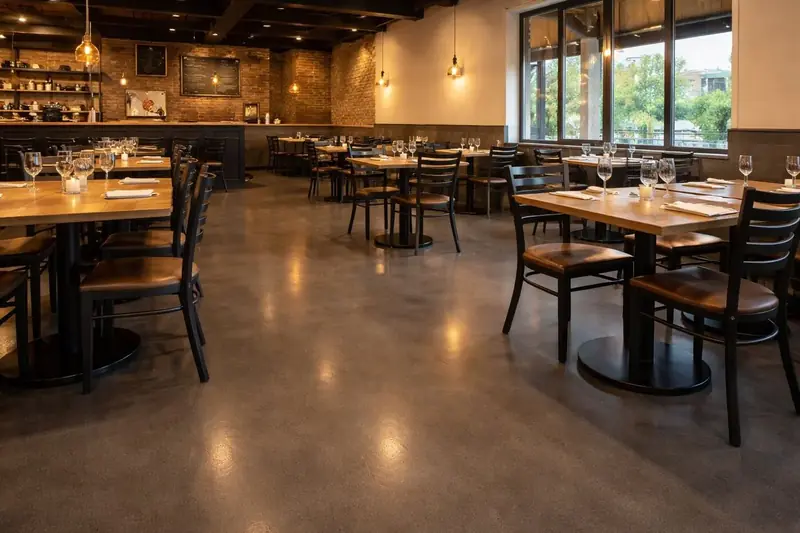
In Palm Beach County, a commercial floor carries an expectation most markets never put on it: it has to perform like industrial equipment and look like it belongs in front of an affluent clientele. The system that delivers both depends on your trade, and on a slab this close to the Atlantic and the Intracoastal, the first thing it depends on is what the moisture meter reads.
This is an unusually demanding county to floor. The economy runs on hospitality, private clubs, and luxury retail where guests notice a hazed or chipped surface, alongside the marine yards on the Intracoastal, the warehouse and distribution corridors inland toward Riviera Beach and Mangonia Park, the auto dealerships off Okeechobee and Northlake, and the medical practices serving a large, older, well-heeled population. A finish that satisfies a Worth Avenue boutique will not survive a yacht-service bay, and a coating built for a forklift aisle would look wrong in a Jupiter clinic. So this guide does not hand you one "commercial floor." It sorts the systems by the work they actually face here, then covers the two coastal conditions that govern every Palm Beach spec, what truly moves the price, and how the job stays out of your way while the floor cures.
Commercial coatings are a core part of what Blake's crew installs at Ascent Epoxy Palm Beach, from storefront and hospitality floors on and around the island to heavy-duty warehouse and fabrication systems in the county's inland industrial parks. Would you rather just walk us through the space? Call (561) 264-5939 and we will come read the slab and put an honest number on it, free.
Why Palm Beach County Businesses Choose Epoxy
For a Palm Beach operator, a coated floor is rarely about appearance alone, and never only about toughness. It is the surface that has to do both at once: hold up to a working day and still photograph well enough for a brand that charges a premium. Here is what it buys a business running in this stretch of the coast.
- A finish that fits the price point. Color depth, metallic movement, and crisp logos or borders can be built right into the floor, so a showroom, club lobby, or boutique reads as deliberate design rather than poured-on industrial gray. In a county where the clientele expects the floor to look intentional, that finish quality is not a nicety, it is part of the spec.
- One continuous surface, nothing to scrub into. Poured epoxy goes down with no grout lines, tile joints, or cold seams, so grease, washdown water, and bacteria have nowhere to lodge. That matters when a county health inspector is standing in a kitchen or a clinic, and a coved base carries the floor right up the wall to close the last dirt trap.
- It absorbs the chemistry of the trade. A correctly matched system ignores the oils, solvents, sanitizers, fuel, and food acids that etch a raw slab, and it takes the steel-wheel and pallet-jack grinding of a working warehouse without dusting or gouging.
- Traction set to the room. A quartz broadcast or anti-slip additive tunes the grip exactly where it is needed, aggressive on a wet cook line or a boat-rinse bay, lighter on a retail floor that still has to mop clean.
- Recoat, not rip-out. When the wear layer finally tires, the topcoat is usually re-applied over the existing build instead of demolished. Set against the recurring patch-and-replace bill for tile, VCT, or sealed concrete, a properly installed epoxy floor is normally the lowest annual cost you can put on a commercial slab.
Commercial Epoxy by Industry
The right floor starts with the work it has to survive, so it is easiest to go trade by trade. Below are the commercial spaces Blake's crew coats most often around Palm Beach County, ordered roughly the way the local economy is weighted, and the system each one tends to land on.
Hospitality, Clubs & Restaurant Kitchens
Hospitality drives a huge share of the county's economy, from private clubs and resorts on the island to the restaurant rows in downtown West Palm and along the Intracoastal. The front-of-house floor has to read polished for a discerning guest, while the kitchen behind it is the hardest-working surface in the building: thermal shock from boiling stockpots and steam cleaning, standing grease and food acids, and a hard county health-code line on a non-slip, sanitary finish. Urethane cement is the answer in the kitchen because it tolerates the heat and chemistry that crack a standard epoxy, with a quartz broadcast for the traction a wet cook line needs and coved integral bases to close the floor-to-wall seam an inspector checks first. The dining room or club lobby can then carry a decorative finish that matches the room's price point.
Marine & Yacht Service
This is signature Palm Beach work. The rinse bays, rigging shops, and service floors along the Intracoastal and the county's waterways see constant fresh and salt water, fuel, two-stroke oil, gel-coat resins, and trailer grit dragged across the slab. The floor has to drain and dry fast, resist that chemical mix without staining, and hold an aggressive grip so a wet bay never turns into a fall. A chemical-resistant flake or solid-color epoxy with a high-traction aggregate topcoat is the baseline, and around the wash-down zones it pays to step up to urethane cement that does not mind sitting wet for hours.
Luxury Retail & Showrooms
From the boutiques on and around Worth Avenue to the showrooms and galleries in the Rosemary and CityPlace district, a retail floor in this county is judged the moment a customer walks in. It needs to look genuinely high-end, take steady foot traffic and rolling display carts, and stay easy to clean without shutting the store. A decorative flake or metallic system delivers that finish, hides the minor scuffs that gather between refreshes, and pairs with a fast-cure topcoat so the doors reopen fast. The same surface that elevates the space also bounces light and makes a smaller footprint feel larger.
Auto Dealerships & Service Bays
The dealership corridors off Okeechobee Boulevard and Northlake run two floors under one roof. The service bays live under hot tires, dropped tools, oil, brake fluid, and solvents, so they need a chemical-resistant flake or solid-color epoxy with a high-grip topcoat that cleans up fast and never lets a spill become a slip hazard. The showroom next door leans the other way, toward a high-gloss decorative finish that keeps the eye on the vehicles and matches the premium inventory these stores carry.
Medical & Clinical
The county's large, older, and affluent population keeps clinics, surgical suites, and dental and imaging practices busy from Boca Raton to Jupiter. Those floors demand the highest hygiene standard: a seamless, non-porous surface that takes repeated disinfection, resists staining from medical chemicals, and holds reliable traction underfoot. Quartz-broadcast systems with coved bases are the common spec, and where sensitive imaging or electronics are present, an ESD or anti-static floor is added to bleed off static charge safely. Every transition and joint is sealed so contamination has nowhere to gather.
Warehouses & Distribution
Inland toward Riviera Beach and the Mangonia Park industrial parks, distribution floors take constant point loading from forklifts, pallet jacks, and racking, plus abrasion from steel wheels and dropped freight. The priorities here are impact and abrasion resistance, clear traffic-lane and safety striping, and dust control so the slab stops shedding concrete powder onto inventory. A high-build flake or solid-color epoxy with a tough polyurethane or polyaspartic topcoat handles most of these floors, while the heaviest loading zones step up to a thicker mortar-grade system.
Choosing the Right System
Name the work and the coating narrows itself down quickly. The grid below maps the five system families that cover nearly all commercial work in Palm Beach County to the room each one is built for.
| System | Key Strength | Best Fit |
|---|---|---|
| Solid-color epoxy | Economical, uniform, easy to clean | Light-traffic back-of-house and storage |
| Flake / broadcast | Durable, hides wear, added grip | Retail and showrooms |
| Quartz | Maximum durability and slip resistance | Kitchens, clinics, and wet areas |
| Urethane cement | Thermal-shock and chemical resistance | Kitchens and food processing |
| ESD / anti-static | Controls static charge | Electronics and medical spaces |
Plenty of Palm Beach jobs blend two of these in one building, which is part of why the county is harder to spec than most: a decorative flake field out front with a urethane-cement zone in the kitchen or wash bay, or a quartz body with an ESD primer in a clinic. Those calls get made on the walkthrough, against your real slab and your real workflow, not off a price sheet.
Not Sure Which System Fits Your Facility?
Tell us your trade, your square footage, and the hours you operate. We will spec the right system for the room, moisture-test the slab, and hand you a real number, free.
The Palm Beach County Factor
Two coastal conditions sit underneath every commercial spec we write in this county, and they are exactly the parts a cheap bid quietly deletes. Ignore either one and a floor that looked flawless on opening day can lift, haze, or peel inside a year, in a building where the owner cannot afford to look anything but finished.
The first is what is coming up through the slab. Palm Beach County sits on a high water table, much of it within a few feet of the Atlantic and the Intracoastal, and a large share of commercial slabs push enough vapor up through the concrete to break a coating loose from underneath no matter how well the surface was prepped. On a commercial floor this is not a judgment call: the slab is moisture-tested before any coating is quoted, and when the reading runs over the safe threshold, a mitigation primer becomes a mandatory part of the build. It is the single biggest cause of commercial floor failure in this market and also the easiest to prevent. Our guide on why floors fail here walks through the full mechanism.
The second is what is coming at the slab from the air. Waterfront restaurants, marine and yacht facilities, open-bay shops, and loading docks all the way up the coast face salt-laden air that chews at coatings along edges, doorways, and exposed surfaces over time. Add the sub-tropical sun on any open or daylit floor and the spec moves toward thicker, UV-stable, chemically resistant systems finished with a polyaspartic or polyurea topcoat that resists ambering and edge breakdown. If your building is near the water or runs with the bay doors open, expect that exposure to show up in the recommendation rather than be glossed over.
Cost & What Drives It
Commercial epoxy in Palm Beach County typically lands between $3 and $8 per square foot installed, set by the system you need and the size of the floor. Bigger floors spread the fixed mobilization, grinding, and prep cost across more area, so the per-foot rate falls as the square footage climbs, while the specialty builds — urethane cement, quartz, and ESD systems — sit at the top of that range because they are thicker and specified by the job. The high-end finishes this market often calls for can carry a premium of their own. Because commercial scope swings so widely, the only honest number comes off a walkthrough, never over the phone.
In practice, five things move a commercial quote here more than anything else:
- System specification. A solid-color storage floor and an ESD-rated imaging suite are not remotely the same price tier; the performance the room demands sets the floor under the cost.
- Slab condition. Cracks, spalling, oil saturation, and old failing coatings each add prep hours before a single coat of new system goes down.
- Moisture mitigation. On a high-water-table coastal slab that tests over the threshold, the mitigation primer is a real, non-negotiable line item, not an upsell.
- Finish level. A working warehouse floor and a metallic showroom floor that has to look the part in front of a luxury clientele are priced very differently, even at the same square footage.
- Downtime windows. Night, weekend, and phased work to keep a club, restaurant, or store trading costs more in labor than an empty building, but it protects the revenue you would otherwise lose.
For the residential and finish-by-finish ranges that anchor the lower end of this scale, see the local cost guide.
Minimizing Downtime
For most operators here the floor is not really the question, the closed days are. In a season-sensitive market where a club, restaurant, or store cannot simply go dark for a week, the real measure of a commercial installer is how little of your operation has to stop. Modern chemistry and a planned sequence make a long shutdown almost always avoidable.
Fast-cure polyaspartic and polyurea topcoats do most of the heavy lifting. Where a traditional epoxy can need days to cure, these chemistries bring a floor back to light service in as little as 24 hours, and they set reliably in Palm Beach County's heat and humidity rather than fighting it. That alone turns most projects from a week-long closure into a long weekend.
The schedule does the rest. A great many commercial floors here go down after hours or across a weekend so the business never stops trading, and when a space is too large to coat in one pass, the work is zoned so only one area is offline while the rest keeps running. An inland warehouse can keep half its racking live, a club or restaurant can coat its kitchen inside a planned closure before peak season, and a showroom floor can be laid section by section overnight. We build that sequence around your hours on the walkthrough, so the plan bends to your operation instead of the reverse.
Frequently Asked Questions
How much does commercial epoxy flooring cost in Palm Beach County?
Most commercial epoxy in Palm Beach County lands between $3 and $8 per square foot installed, driven by the system and the size of the floor. Larger floors come in lower per foot because the prep and mobilization spread out, while urethane cement, quartz, and ESD systems sit at the top of the range, and the high-end finishes this market often wants can add a premium. An accurate figure comes off an on-site walkthrough that checks the slab and moisture-tests it, not over the phone.
What is the best epoxy floor for a commercial kitchen?
For a Palm Beach County restaurant or club kitchen, urethane cement or a quartz-broadcast system is the right call. Both shrug off the thermal shock of hot spills and steam cleaning, resist food acids and grease, and carry the slip rating a wet cook line needs to clear a county health inspection. Coved integral bases run the floor up the wall so there is no seam for bacteria to sit in, which is the first thing an inspector looks for.
How long does commercial epoxy last?
A professionally installed commercial floor in Palm Beach County usually runs 5 to 10 years under heavy traffic before it wants a refresh, and the topcoat can often be recoated rather than torn out. The lifespan tracks the system, the traffic load, and whether the slab was properly ground and moisture-tested up front. On a coastal high-water-table slab, skipped prep and skipped moisture mitigation are the two reasons a floor fails early here.
Can you install commercial epoxy without closing my business?
Usually, yes, which matters in a market where a club, restaurant, or store cannot afford dark days. Fast-cure polyaspartic and polyurea systems bring a floor back to service in as little as 24 hours, and the work can be zoned so only one area is offline at a time. After-hours and weekend scheduling keeps most retail, dealership, marine, and warehouse spaces trading while the floor goes down in stages. We map that sequence to your hours on the walkthrough.
Is urethane cement better than epoxy for kitchens?
For a commercial kitchen or food-processing room, urethane cement is generally the stronger choice. It takes the thermal shock of boiling water and steam cleaning that can crack a standard epoxy, and it resists the acids and oils that come with food service. Standard epoxy is excellent for showrooms, retail, and warehouse floors, but the kitchen and any wet processing zone is where urethane cement earns its premium.
Do commercial slabs in Palm Beach County need moisture mitigation?
Many do. With much of the county sitting a few feet above the water table near the Atlantic and the Intracoastal, a large share of commercial slabs push enough vapor up through the concrete to break a coating loose from underneath. A real installer moisture-tests the slab before quoting, and when the reading runs over the safe threshold, a mitigation primer is built into the system. It is the single most important step for a commercial floor that lasts on this coast.
Get Your Personalized Palm Beach County Commercial Quote
This guide hands you the systems and the reasoning, but the number that fits your building only comes from putting eyes and a moisture meter on your actual slab. At Ascent Epoxy Palm Beach, every commercial estimate starts with a real look at the concrete, a moisture reading, and a straight conversation about which system suits your trade, your traffic, your finish expectations, and the hours you cannot afford to close. No pressure, no bait-and-switch, just a clear plan and a floor engineered for this coast.
Ready to start? Call (561) 264-5939 or request a free quote online. We coat commercial floors in West Palm Beach, Palm Beach, Jupiter, Riviera Beach, Palm Beach Gardens, Boynton Beach, Delray Beach, Lake Worth, Royal Palm Beach, Wellington, Boca Raton, and the surrounding communities across Palm Beach County.
Related Articles
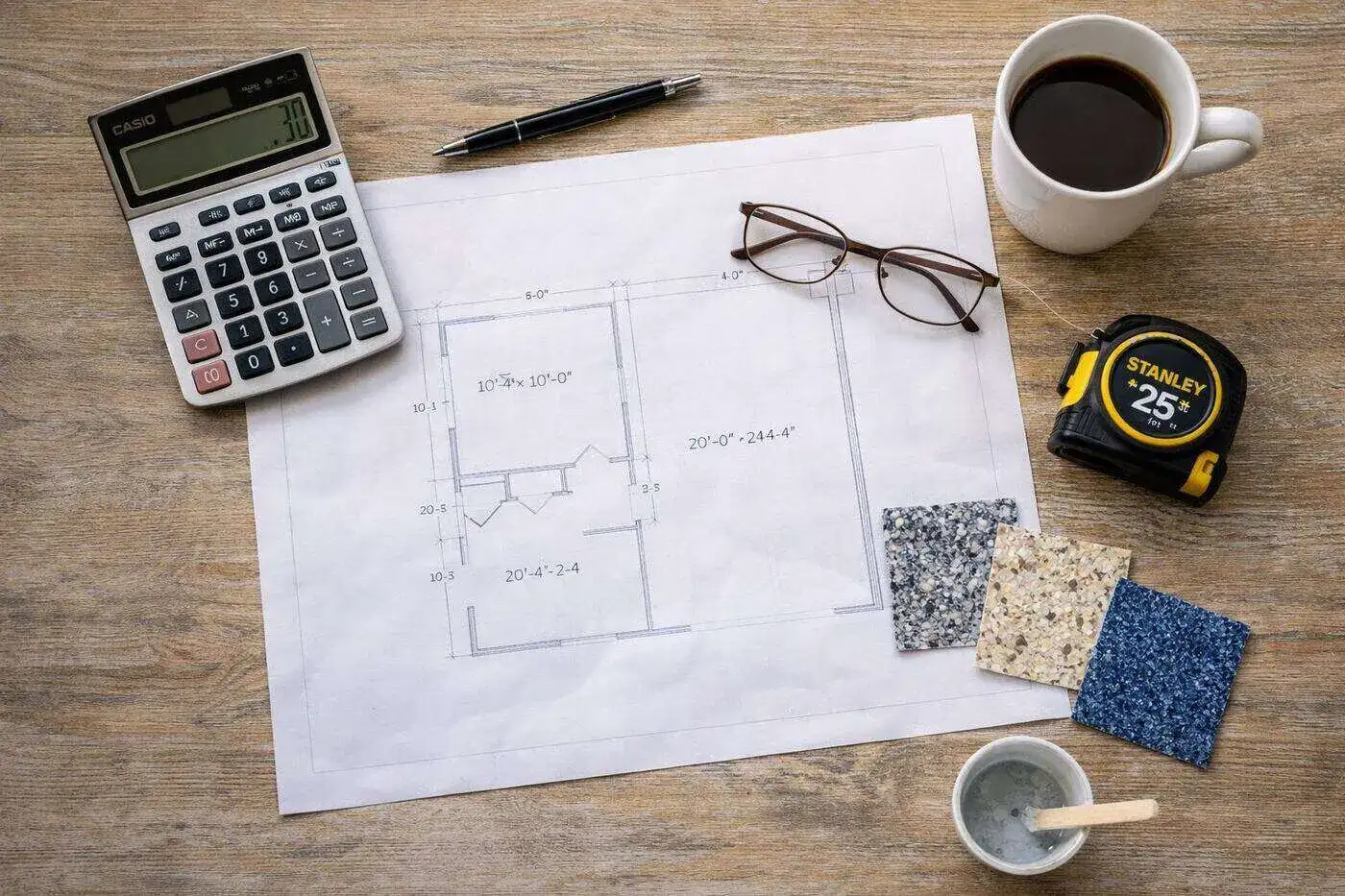
How Much Does Epoxy Flooring Cost in Palm Beach County? (2026 Guide)
Real prices by finish and a typical 2-car garage total.
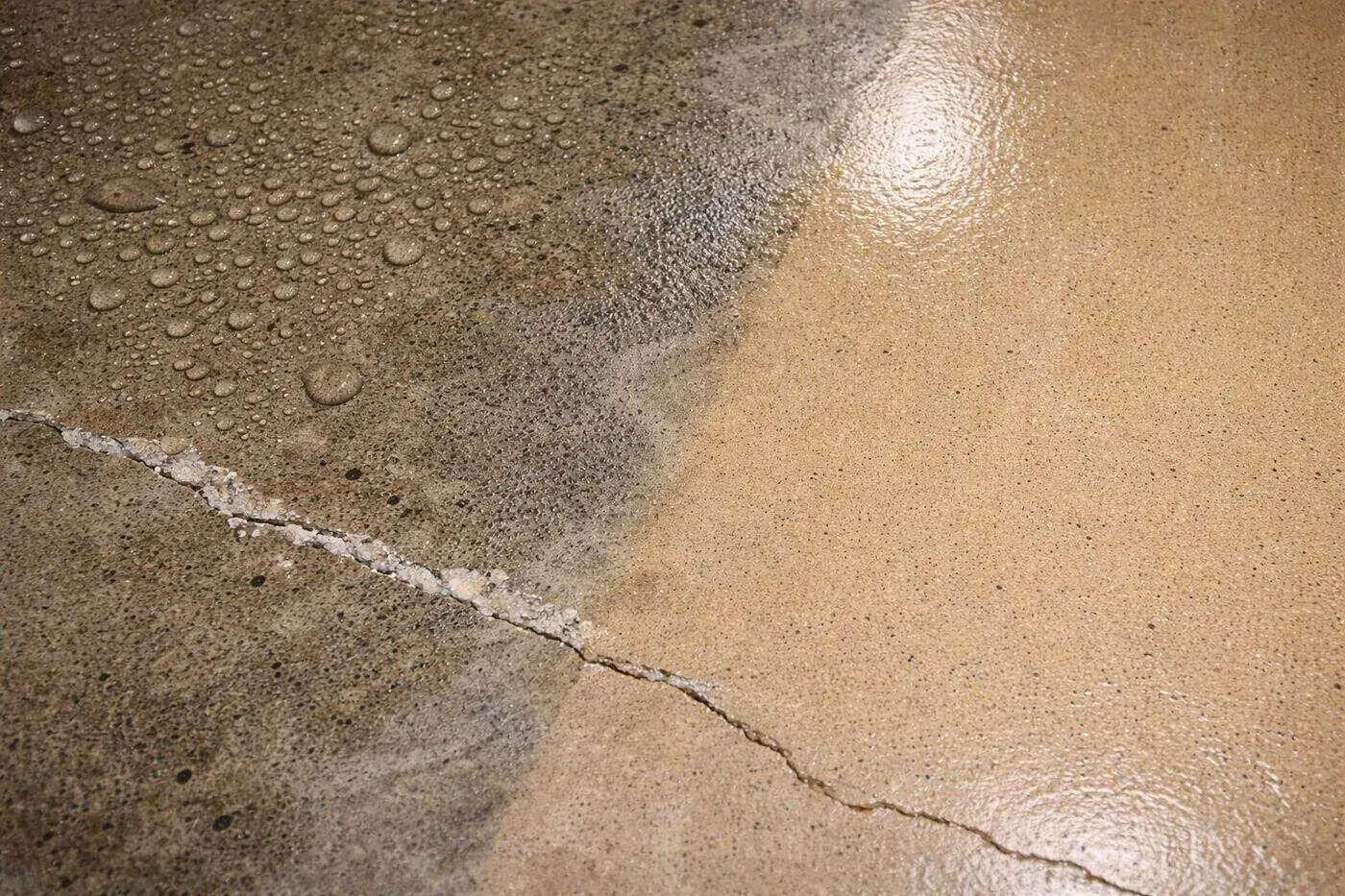
Why Epoxy Floors Fail in Palm Beach County — and the Moisture Test That Prevents It
The high water table, MVT testing, and what to ask before you sign.
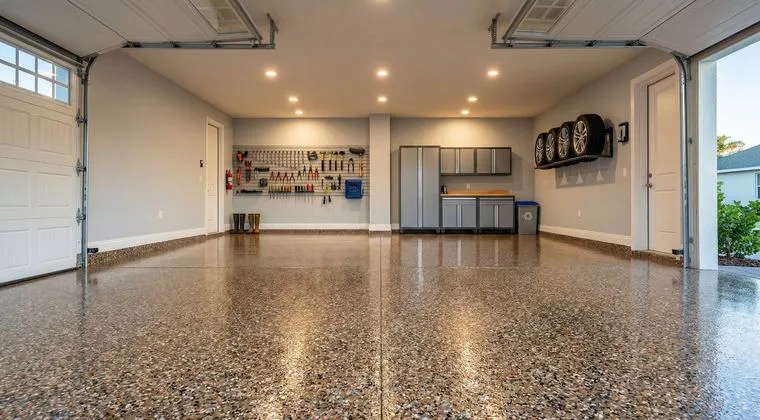
How Long Does an Epoxy Floor Last in Palm Beach County?
Realistic lifespans and what shortens them in South Florida.